

Key Takeaways
- Creators who rely on a single revenue stream leave their businesses vulnerable to algorithm shifts or affiliate program changes.
- Building an email list from day one provides direct distribution independent of search engine updates.
- Building a profitable digital publication is a long-term endeavor that compounds with consistency, audience trust, and a diversified revenue engine.
Table of Contents
- 1. Realistic Traffic, Post Counts, and Timelines for Blog Income
- 2. Proven Monetization Models to Earn from Your Blog
- 3. High-Paying Niches and RPM Variance in 2026
- 4. Adapting to Google Search Updates, AI Search, and Content Quality
- 5. Why Most Blogs Fail and How to Build a Resilient Content Business
- 6. Frequently Asked Questions about Blog Monetization
- 7. Conclusion
To earn from your blog in today's digital landscape, you need a clear roadmap that pairs consistent audience growth with diversified revenue streams. Whether you are launching a brand-new platform or scaling an established publication, turning written content into a sustainable online business requires grounded traffic expectations, strategic keyword targeting, and practical monetization milestones. This step-by-step guide breaks down realistic timelines, post count targets, and proven models to help you grow your publication into a reliable income generator.
Realistic Traffic, Post Counts, and Timelines for Blog Income
To earn from your blog, start by publishing targeted, high-intent content that builds organic search traffic, then layer monetization across affiliate marketing, display ads, and digital products. Building a sustainable blogging business requires grounded expectations. Data from extensive creator surveys, such as Statistics from the 2026 Blogging Income Survey, indicates a strong correlation between site age, post volume, and revenue. Publishers who have maintained their platforms for over a decade consistently reach higher income brackets than newer sites, largely because domain authority, backlink profiles, and topical breadth compound over time.
While the mean timeline to earn a first dollar sits around 21 months, the median is 12 months. Roughly one-quarter of creators achieve initial monetization within their first six months by focusing on high-intent affiliate links or targeted services. Scaling to a full-time income typically takes longer: the median timeline is 48 months (4 years), though approximately 24% of dedicated publishers reach full-time earnings within two years.
Publishing volume plays a direct role in traffic acquisition. Industry benchmarks illustrate that blogs with 500 to 999 high-quality articles earn an average of $9,460 per month, compared to newer properties with fewer than 100 posts. However, quality must remain paramount; publishing low-value entries simply to increase volume leads to algorithmic penalties rather than revenue growth.
| Monetization Tier | Monthly Earnings Range | Monthly Sessions Needed | Typical Post Count | Primary Revenue Drivers |
|---|---|---|---|---|
| Starter | $0 – $200 | 0 – 10,000 | 20 – 60 | Amazon Associates, basic digital downloads |
| Growth | $500 – $1,500 | 25,000 – 50,000 | 75 – 150 | Mid-tier display ads, affiliate programs, small sponsorships |
| Scale | $3,000 – $5,000 | 75,000 – 120,000 | 150 – 350 | Premium ad networks, custom digital products, sponsored campaigns |
| Full-Time Enterprise | $5,000 – $10,000+ | 120,000 – 250,000+ | 400 – 800+ | Hybrid monetization: ads, recurring SaaS affiliates, courses |
When you learn how to start a blog, establishing clear targets based on real-world data prevents early burnout and keeps your editorial pipeline structured.
Laying the Foundation to Earn from Your Blog in Year One
The first twelve months of blogging are primarily an infrastructure phase. Total out-of-pocket setup costs can easily remain under $30 per month (or roughly $50 to $120 for the entire first year), covering basic domain registration and reliable shared hosting.
During the initial 6 to 9 months, major search engines evaluate your site within an algorithmic trust sandbox. Site traffic may remain low despite regular publishing. Success during this period relies on targeting zero-to-low competition long-tail keywords that answer hyper-specific consumer questions. Rather than writing broad think-pieces, produce comprehensive evergreen content focused on direct problem-solving. Layer basic affiliate tracking into these initial guides to validate intent and ensure that your early visitors can take commercial action.
Milestones to Reach $1,000, $3,000, and $5,000 Monthly Revenue
Scaling your earnings through intermediate revenue tiers requires aligning publishing velocity with buyer intent:
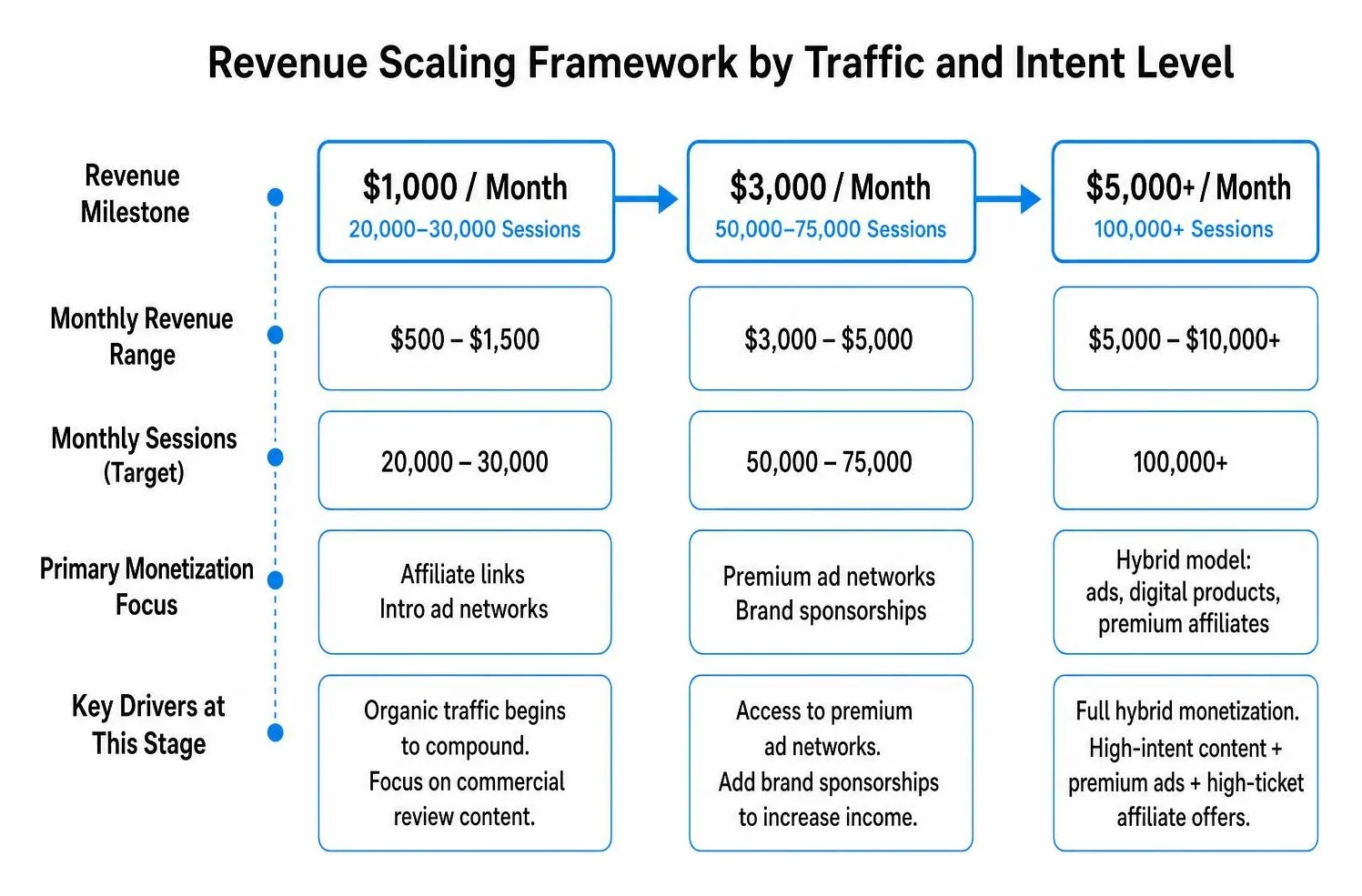
- Reaching $1,000/Month (Approx. 20,000–30,000 Sessions): At this stage, organic search traffic begins to compound. By leveraging practical beginner methods to monetize a blog, you can generate baseline earnings through focused commercial review content and introductory ad networks.
- Reaching $3,000/Month (Approx. 50,000–75,000 Sessions): Crossing 50,000 monthly sessions opens access to premium managed header bidding ad networks, which significantly increases ad RPMs. Pairing these placements with direct brand sponsorships elevates monthly income.
- Crossing $5,000/Month (100,000+ Sessions): Achieving this level involves a full hybrid model. Real-world case studies show that scaling to 112,000 monthly sessions in high-intent niches can produce over $5,200 monthly by layering digital templates, premium ads (yielding $30+ RPMs), and high-ticket affiliate programs.
Proven Monetization Models to Earn from Your Blog
Creators who rely on a single revenue stream leave their businesses vulnerable to algorithm shifts or affiliate program changes. Survey data confirms that publishers who activate four or more distinct revenue streams earn over four times more revenue per thousand visitors (RPM) than those dependent on a single channel. Detailed insights from the Blogging Income Growth Guide highlight that integrating multiple income streams is essential to earn passive income from your website predictably.
Display Advertising and Network Progression RPMs

Display advertising remains one of the simplest ways to monetize informational content. However, revenue per thousand sessions (RPM) varies dramatically based on your ad technology partner:
- Entry-Level (0 – 10k sessions): Basic networks provide accessible entry points with modest RPMs ($5–$12).
- Mid-Tier (10k – 50k sessions): Advanced platforms offer optimization algorithms, lifting RPMs into the $15–$25 range.
- Premium Managed Networks (50,000+ sessions): Managed header bidding networks connect your inventory to dozens of demand-side platforms (DSPs), often yielding RPMs between $25 and $55+ in commercial verticals.
To protect user experience and search rankings, maintain strict Core Web Vitals compliance. Reserve explicit CSS min-height parameters on ad containers to prevent Cumulative Layout Shift (CLS), and implement lazy loading for below-the-fold units. Establishing trust across your vertical using our complete EEAT guide ensures your traffic remains high enough to qualify for and retain premium network partnerships.
High-Intent Affiliate Marketing and Direct Brand Sponsorships
Affiliate marketing generates revenue by recommending products and services you trust. While standard consumer retail programs offer baseline conversions, top-earning blogs prioritize software-as-a-service (SaaS) and digital service partners that offer recurring monthly commissions. Explore specialized affiliate marketing programs in your niche to secure consistent, compounding payouts.
Alongside affiliate links, securing direct paid sponsored posts allows you to monetize your authority directly. Brand partners regularly pay flat rates or performance bonuses to access engaged readers. When running sponsored campaigns, always maintain editorial integrity and follow FTC guidelines by providing clear, upfront disclosures at the beginning of each article.
Scaling Email Lists to Earn from Your Blog With Digital Products
Digital products—including downloadable toolkits, spreadsheet systems, design templates, and comprehensive guides—represent the highest-margin monetization model available to creators. Industry surveys indicate that the average effective RPM for digital products exceeds $535, which is more than sixteen times higher than average display advertising returns ($33.16 RPM).
Building an email list from day one provides direct distribution independent of search engine updates. Offer targeted lead magnets tailored to specific search intents, then implement automated nurture sequences to guide subscribers toward paid solutions. By mastering how to make money with digital products, smaller blogs with modest traffic can out-earn massive lifestyle properties that rely exclusively on ad impressions.
High-Paying Niches and RPM Variance in 2026
Monetization efficiency varies significantly across subject verticals. A blog focused on broad entertainment might generate a $10 display ad RPM, whereas a specialized personal finance or enterprise technology site can command ad RPMs of $40 to $70+ on identical traffic volumes.
Audience geography also impacts commercial valuation. US-based visitors set the global baseline for programmatic ad spending (1.0x multiplier), while traffic from markets with lower advertiser density yields lower CPM rates. Understanding how to identify your niche target audience ensures you build an audience profile that attracts premium brand budgets.
Top Niche RPM Benchmarks and Commercial Value
| Vertical / Niche | Average Display Ad RPM | Affiliate Commission Potential | Primary Commercial Offerings |
|---|---|---|---|
| Personal Finance & Investing | $35 – $70+ | High (Recurring SaaS, Brokerages) | Financial tools, software, advisory funnels |
| B2B Software & Marketing | $30 – $65 | High (Enterprise SaaS, CRM Tools) | Tool subscriptions, agency services |
| Health, Fitness & Biohacking | $25 – $50 | Medium to High (Supplements, Gear) | Specialized equipment, fitness courses |
| Home Improvement & Tech DIY | $20 – $40 | Medium (Retail, Tool Brands) | Physical products, blueprints |
| Food, Recipes & Lifestyle | $15 – $35 | Low to Medium (Kitchenware, Grocers) | Cookbooks, printable meal planners |
To maximize inventory value, structure your content to establish deep topical authority across sub-topics before expanding outward. Implementing deliberate frameworks to reach your target audience with tailored buyer-intent content ensures steady, highly qualified traffic.
Adapting to Google Search Updates, AI Search, and Content Quality
Search engines prioritize first-hand experience, transparent sourcing, and distinct editorial viewpoints. Generic informational content is increasingly answered directly within AI search overviews, making unique analysis and original reporting essential for retaining organic traffic.
When using AI writing tools for bloggers, treat machine output as a preliminary drafting and outlining assistant rather than a finished product. Enhance every article with personal data points, custom screenshots, contrarian analysis, and structured comparison tables. Additionally, conduct semi-annual content audits to prune or update low-performing, outdated posts, protecting your overall domain health.
Why Most Blogs Fail and How to Build a Resilient Content Business
The primary reason blogs fail to generate meaningful income is premature abandonment. Because the organic compounding curve requires 12 to 24 months of consistent output before search algorithms fully recognize domain trust, many publishers stop writing just before reaching their growth inflection point.
Other critical missteps include relying entirely on a single monetization channel, failing to build an email list, and cluttering the reading experience with aggressive popups that hurt Core Web Vitals. Following practical steps to grow your blog systematically through audience diversification, email capture, and brand partnerships ensures your digital property matures into a resilient business asset.
Frequently Asked Questions about Blog Monetization
How much traffic do I need before I can make money?
You do not need massive traffic to start earning. By incorporating targeted affiliate recommendations and high-utility digital downloads, blogs with 1,000 to 5,000 monthly sessions can generate their first $100 to $500. Display ad networks generally require 10,000 to 50,000 monthly sessions for entry, but direct brand collaborations and affiliate sales can begin much earlier.
What is the most profitable revenue stream for smaller blogs?
Digital products and direct consulting services offer the highest return for small blogs. Because proprietary digital downloads command average RPMs upwards of $500, a focused site with only 5,000 monthly sessions can generate thousands of dollars by selling specialized templates, toolkits, or coaching directly to an engaged subscriber base.
How do search engine updates affect blog monetization?
Search updates reward sites demonstrating genuine Experience, Expertise, Authoritativeness, and Trustworthiness (E-E-A-T). Publishers who rely on thin, unoriginal copy risk traffic volatility, whereas creators who incorporate hands-on testing, original research, and multi-channel audience capture (like email newsletters and social platforms) protect and grow their income over time.
Conclusion
Building a profitable digital publication is a long-term endeavor that compounds with consistency, audience trust, and a diversified revenue engine. By progressing from initial affiliate recommendations and list building to high-RPM display advertising and direct digital product sales, you create a sustainable business asset that stands resilient against algorithm changes.
If you are ready to expand your site's earning potential with paid brand collaborations, explore Valued Voice. Our platform gives you complete price control, editorial freedom, and streamlined payouts to connect your publication with leading brands. Combine high-quality publishing with a comprehensive white hat link building strategy to continuously elevate your domain authority and maximize your long-term blogging revenue.