Key Takeaways
- From February 1, 2027, new ad-revenue applicants need 1,000 subscribers plus 8,000 qualified watch hours or 20 million qualified Shorts views.
- Existing partners should review the relevant updated terms by January 31, 2027; the higher entry thresholds do not change their existing YPP status.
- Shorts Creator Pool earnings have a separate monthly qualification rule; sponsorships, memberships, Shopping, and an owned website can diversify income.
Table of Contents
- 1. YouTube monetization requirements in 2027: eligibility checklist
- 2. What changes on February 1, 2027?
- 3. Ways to earn on YouTube beyond ad revenue
- 4. Why a Website Is Important for Your YouTube Channel
- 5. Content policies, application review, and getting paid
- 6. Frequently asked questions about YouTube monetization requirements
- 7. Conclusion
YouTube monetization is shifting in 2027, and creators need a clear picture of the new Partner Program rules before they plan their next upload. This guide breaks down the updated eligibility thresholds, what changes for Shorts, and the non-ad income streams that can keep your channel growing.
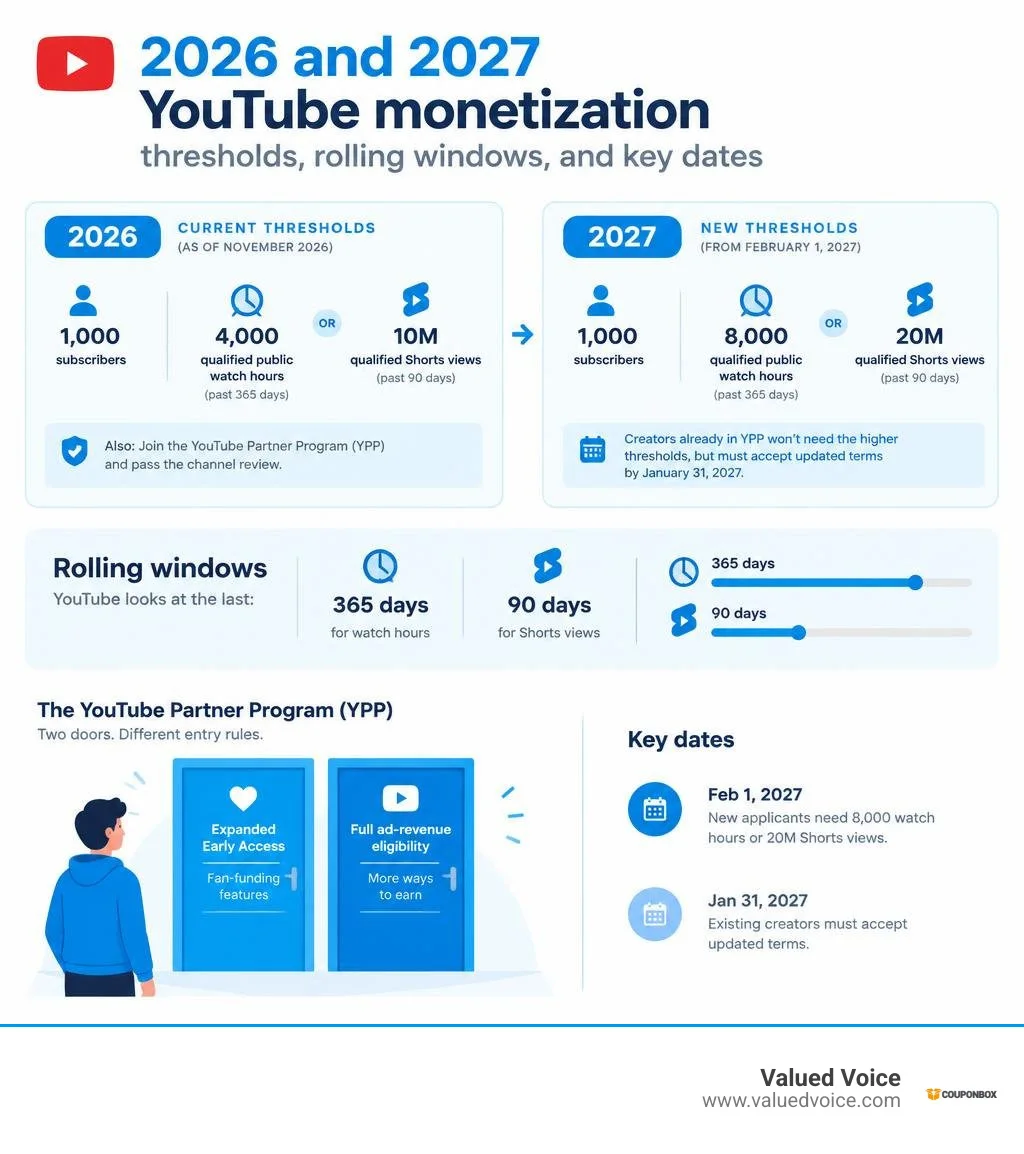
As of November 2026, YouTube monetization requirements for ad revenue are 1,000 subscribers and either 4,000 qualified public watch hours in the past 365 days or 10 million qualified Shorts views in the past 90 days. You must also join the YouTube Partner Program (YPP) and pass its channel review.
Starting February 1, 2027, new applicants will need 8,000 qualified watch hours or 20 million qualified Shorts views in those same windows, plus 1,000 subscribers. Creators already in YPP will not have to meet the higher entry thresholds, but must accept the relevant updated terms by January 31, 2027 to keep earning from those features. See YouTube’s official program changes. This guide breaks down the eligibility checklist, what changes for Shorts, and ways to earn beyond ads.
YouTube monetization requirements in 2027: eligibility checklist
Think of YPP as a club with two doors. The first door (Expanded Early Access) opens fan-funding features. The second opens the full ad-revenue room. Each has its own entry rules, and the official How to earn money on YouTube page lists them by feature. Both use rolling windows: YouTube looks at the last 365 days for watch hours and the last 90 days for Shorts views. Your channel's age does not matter, and anything older than the window simply stops counting.
| Expanded Early Access | Full ad-revenue eligibility | |
|---|---|---|
| Subscribers | 500 | 1,000 |
| Public uploads | 3 in the last 90 days | Not part of the threshold |
| Long-form route | 3,000 qualified public watch hours (365 days) | 4,000 now, 8,000 for new applicants from Feb 1, 2027 |
| Shorts route | 3 million qualified Shorts views (90 days) | 10 million now, 20 million for new applicants from Feb 1, 2027 |
| What you unlock | Memberships, Super Chat, Super Stickers, Super Thanks, Shopping | Ads, Premium revenue, plus the fan-funding features |
What are the YouTube monetization requirements for full ad revenue?
Here is the checklist for ad revenue:
- 1,000 subscribers.
- Either 8,000 qualified public watch hours in the last 365 days, or 20 million qualified Shorts views in the last 90 days (for new applicants from February 1, 2027). Until then, the numbers are 4,000 and 10 million.
- Residence in a country or region where YPP is available.
- No active Community Guidelines strikes.
- 2-Step Verification turned on.
- Access to advanced features.
- An AdSense for YouTube account linked to your channel.
- Age 18 or over, or a legal guardian over 18 who handles payments.
- Content that follows the monetization policies and advertiser-friendly guidelines.
You only need one route, long-form or Shorts, not both. Qualified public watch hours come from public long-form videos. They exclude Shorts, private, unlisted, and deleted videos, and ad campaigns.
What does Expanded Early Access unlock?
If you have 500 subscribers, 3 public uploads in the last 90 days, and either 3,000 qualified public watch hours (365 days) or 3 million qualified Shorts views (90 days), you can switch on:
- Channel memberships
- Super Chat and Super Stickers
- Super Thanks
- YouTube Shopping
What you do not get is a share of Watch Page or Shorts Feed ad revenue. You also cannot be set as Made for Kids, and you must accept the Commerce Product Module.
What changes on February 1, 2027?
This is the first significant change to YPP eligibility since 2018, and it effectively doubles the entry bar. YouTube says it is keeping pace with a platform that now sees over 200 billion daily Shorts views. Here is who is affected:
- New applicants: 8,000 qualified watch hours or 20 million qualified Shorts views, plus 1,000 subscribers.
- Existing YPP creators: not affected by the higher entry thresholds, but you must review and accept the updated terms in YouTube Studio by January 31, 2027 to keep fully monetizing.
- Fan funding and Shopping: thresholds stay the same.
The official YouTube Partner Program update explains the announced changes if you want the first-party view. Some commentators worry the higher bar could discourage niche creators. We think that concern is fair, which is why the non-ad income covered below matters so much.
How YouTube monetization requirements differ for long-form and Shorts
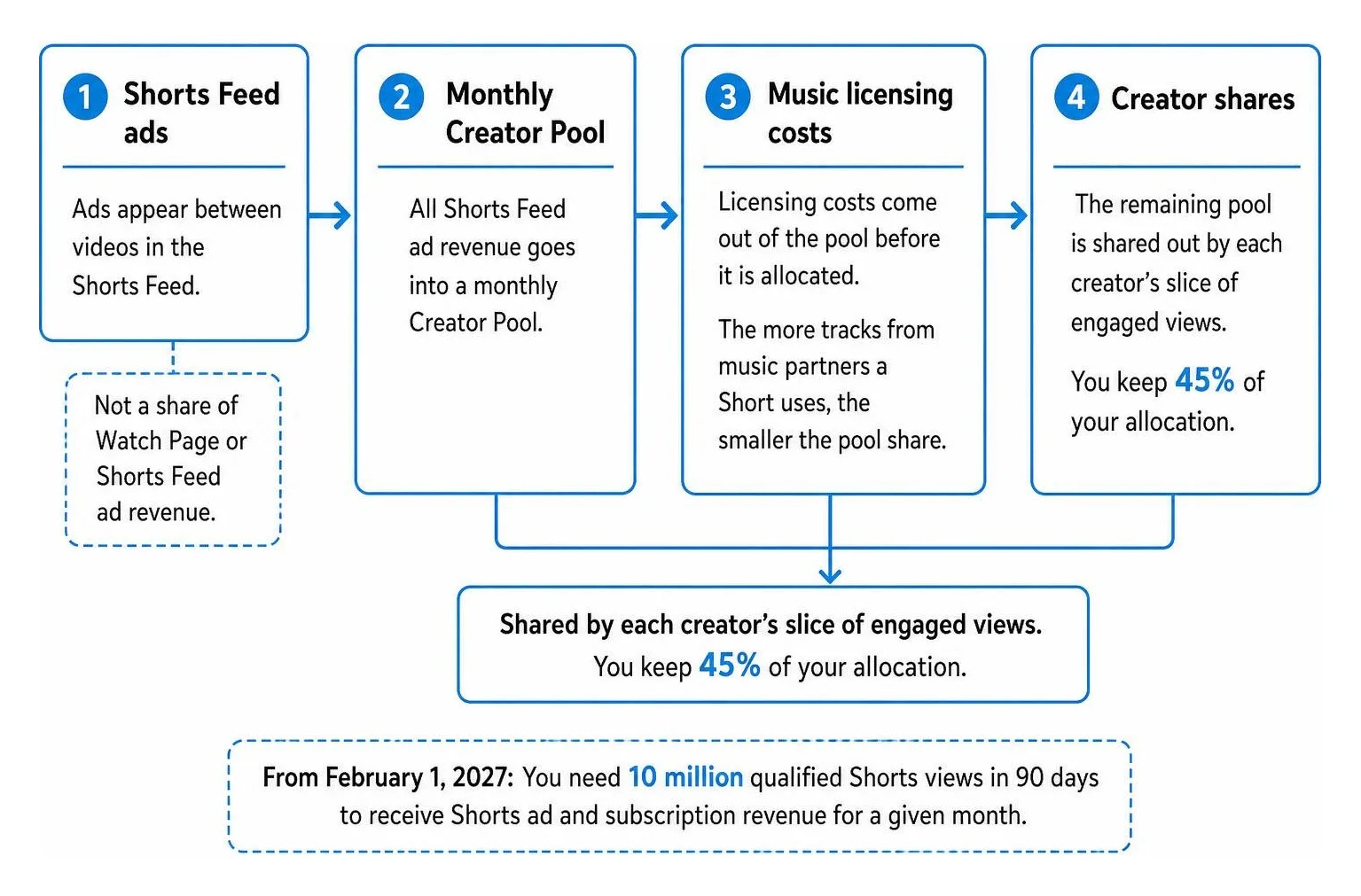
Long-form videos earn from ads shown on the Watch Page, and you keep 55% of that revenue. Shorts earn differently. Ads appear between videos in the Shorts Feed, and the revenue goes into a monthly Creator Pool. That pool is shared out by each creator's slice of engaged views, and you keep 45% of your allocation.
Music matters here. Licensing costs come out of the pool before it is allocated, and the more tracks from music partners a Short uses, the smaller the pool share. Your 45% does not shrink, though.
From February 1, 2027, there is an additional gate: you need 10 million qualified Shorts views over the 90 days ending on the 15th of the previous month to receive Shorts Creator Pool ad and subscription revenue for a given month. The official Shorts monetization policy explains this measurement window and the separate direct-revenue rules for targeted Shorts ads.
| Long-form | Shorts | |
|---|---|---|
| Entry (new applicants, Feb 2027) | 8,000 qualified watch hours in 365 days | 20 million qualified views in 90 days |
| Where ads run | Watch Page | Between videos in the Shorts Feed |
| Revenue model | Per-video ad revenue | Monthly Creator Pool |
| Creator share | 55% | 45% |
| Ongoing Shorts requirement | None beyond policies | 10 million qualified views in 90 days |
Qualified views must be original, follow advertiser-friendly guidelines, and not come from bots or artificial scrolling. Views from before you accept the Shorts Monetization Module do not count for revenue.
What happens to Shorts channels below the new threshold?
You stay in YPP, and long-form earnings carry on as normal. Only Shorts ad and subscription revenue sharing pauses while you are under 10 million qualified views in 90 days. It resumes automatically when you cross the line again.
YouTube also plans milestone-based incentives for smaller channels, such as YouTube Shopping bonuses, brand-deal incentives, and boosts for starting or growing trends. Details have not been fully announced, so watch YouTube's official updates before building a plan around them.
How do YouTube Premium and Premium Lite pay creators?
When a Premium subscriber watches your content, you earn a share of their subscription fee. Creator pools are 30% of net Premium subscription revenue and 60% of net Premium Lite revenue. Premium Lite is a cheaper tier with uninterrupted, offline, and background viewing of most content, and it is expanding to every country where Premium is offered.
Money is distributed by member watch time and views, with the same 55% long-form and 45% Shorts shares. YouTube says that, based on 2026 performance, partners on average earn more when a viewer signs up for Premium than when that viewer watches ads. You can review and sign the new terms in YouTube Studio.
Ways to earn on YouTube beyond ad revenue
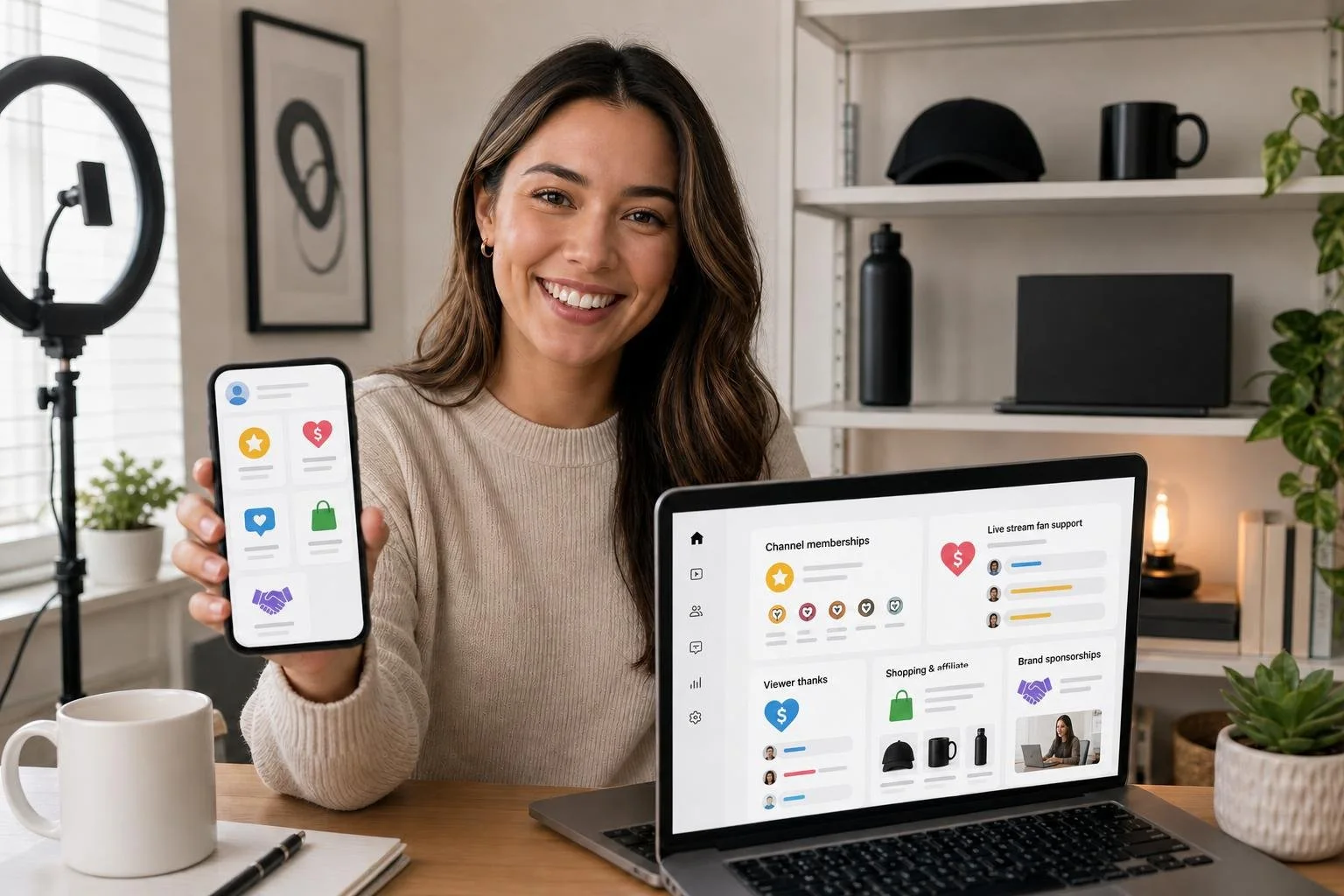
Ads are only one stream. More than half of YPP channels that earned five figures or more in 2024 also earned from sources beyond ads and Premium. The official YouTube partner earnings overview covers the details. Your options include memberships, Super Chat, Super Stickers, Super Thanks, Shopping and affiliate products, Premium revenue, and brand sponsorships. If you want ideas beyond YouTube, our guides on how to make money as an influencer and how much influencers make are a good start.
How do non-ad monetization features work?
- Channel memberships: fans pay a recurring monthly fee for perks.
- Super Chat and Super Stickers: viewers pay to highlight messages or animated images in live chat.
- Super Thanks: viewers pay for an animation and a highlighted comment on a video or Short.
- Shopping: sell your own products or tag affiliate products from other brands.
Channel memberships, Super Chat, Super Stickers, and Super Thanks sit under the Commerce Product Module, where creators receive 70% of net revenue. Shopping payments and affiliate commissions follow separate retailer, platform, or affiliate-program arrangements; that 70% rate is not a Shopping commission. Each feature has its own eligibility and location rules. See the YouTube partner earnings overview. Earnings may be taxable in your country of residence, and Google withholds U.S. tax on U.S. viewers’ earnings, so check with a tax professional.
Why a Website Is Important for Your YouTube Channel
Your channel lives on rented land. Algorithms shift, thresholds double, and Shorts revenue can pause. A website gives you something you own. It lets you:
- Capture search traffic that YouTube may never send you.
- Build an email list so you can reach fans directly.
- Place affiliate links and sell digital products. Our guides on earning income from your website and making money with digital products show how.
- Host a sponsorship media kit that brands can find.
If you are starting from zero, see how to start a blog. Once your blog has readers, Valued Voice connects bloggers and influencers with brands for paid sponsored content, with sponsored content opportunities that fit their audience.
Content policies, application review, and getting paid
Reaching the numbers is only half the battle. YouTube also checks that your channel is original, advertiser-friendly, and compliant with the Community Guidelines, copyright rules, and its creator responsibility standards. Everything is spelled out in the official YouTube channel monetization policies.
What content can prevent or end monetization?
Common problems include:
- Reused content: clips, compilations, or scraped material without meaningful commentary or transformation. This is separate from copyright and applies even with permission.
- Inauthentic content: mass-produced, templated, or repetitive videos. The old "repetitious content" policy was renamed in July 2025.
- Unsatisfying or off-putting content: shock-only videos, deceptive imagery, or emotionally manipulative formulas.
- Low-quality Made for Kids content: heavily promotional, deceptively educational, or hard to follow.
- Artificial engagement: bought views, subscribers, or watch hours, or creating new channels to dodge a suspension.
- Ad-unfriendly content: anything outside the advertiser-friendly guidelines.
Allowed examples include a series where each video has a distinct focus, and reaction videos with real commentary. Violations can mean limited ads, suspension, or even termination, and earnings can be withheld or adjusted for up to 90 days during investigations.
How do AI-generated content and AI personas affect eligibility?
AI tools are fine when your final video shows a creative vision, a real narrative, and an original perspective. Stitching random AI clips together with no story, or mass-producing near-identical uploads, risks the inauthentic content policy. Channels using AI personas that present as human experts on health, legal, financial, or political topics, such as an AI doctor giving diagnoses, cannot monetize. Disclose realistic synthetic content where YouTube requires it.
How does YouTube review a YPP application?
- Open YouTube Studio and go to the Earn tab.
- Accept the YPP terms.
- Link your AdSense for YouTube account.
- Wait for review, which YouTube says typically takes about one month; delays are possible.
Reviewers look at the channel as a whole: main theme, most-viewed and newest videos, the biggest share of watch time, titles, thumbnails, descriptions, and your About section. If you are rejected, fix the problem (often reused content, copyright or guideline issues, or inflated engagement). You can appeal within 21 days or reapply after 30 days, and a longer wait applies after a second application.
How do creators receive their earnings?
Once you are in, you will confirm your personal and address details, submit tax information, pick a payment method, and reach the payment threshold. Skip the tax info and Google may withhold up to 24% of worldwide earnings. A mailed verification PIN can take 3 to 4 weeks. Earnings below the threshold roll over, and payment holds can delay payouts. Follow the steps in How to get paid on YouTube.
Frequently asked questions about YouTube monetization requirements
Do Shorts watch hours count toward the long-form watch-hour threshold?
No. Public watch hours come from eligible public long-form videos in a rolling 365-day window. Shorts have their own path based on views in a rolling 90-day window.
Can an older channel still qualify for YPP?
Yes. Channel age is irrelevant. Only the last 365 days (watch hours) or 90 days (Shorts views) count, so older numbers do not help, but you can keep going until you hit the threshold. Once in, you must keep following the policies to stay eligible.
How many views does it take to earn $1,000 on YouTube?
There is no fixed view count that guarantees $1,000. As a hypothetical calculation, an RPM of $2 would require 500,000 views, while an RPM of $10 would require 100,000 views. These are examples, not typical rates or earnings promises. RPM measures creator revenue per 1,000 views and may include several revenue sources; CPM measures what advertisers pay per 1,000 ad impressions. Niche, audience location, format, and demand affect the result. Sponsorships provide another income stream; see our guide on making money as an influencer.
Conclusion
Here is your 2027 checklist: build toward 1,000 subscribers and 8,000 qualified watch hours or 20 million qualified Shorts views, keep your policies clean, and accept the updated terms by January 31, 2027 if you are already in YPP. Track your numbers in rolling windows, and do not rely on ads alone.
Diversify with memberships, Shopping, sponsorships, and a website you own. When you are ready to turn your audience into paid brand partnerships, Valued Voice is here to help. Start with our beginner's guide to making money blogging.