
Jul 27, 2026


What Makes a Website Attractive to Advertisers (And Why It Matters in 2026)
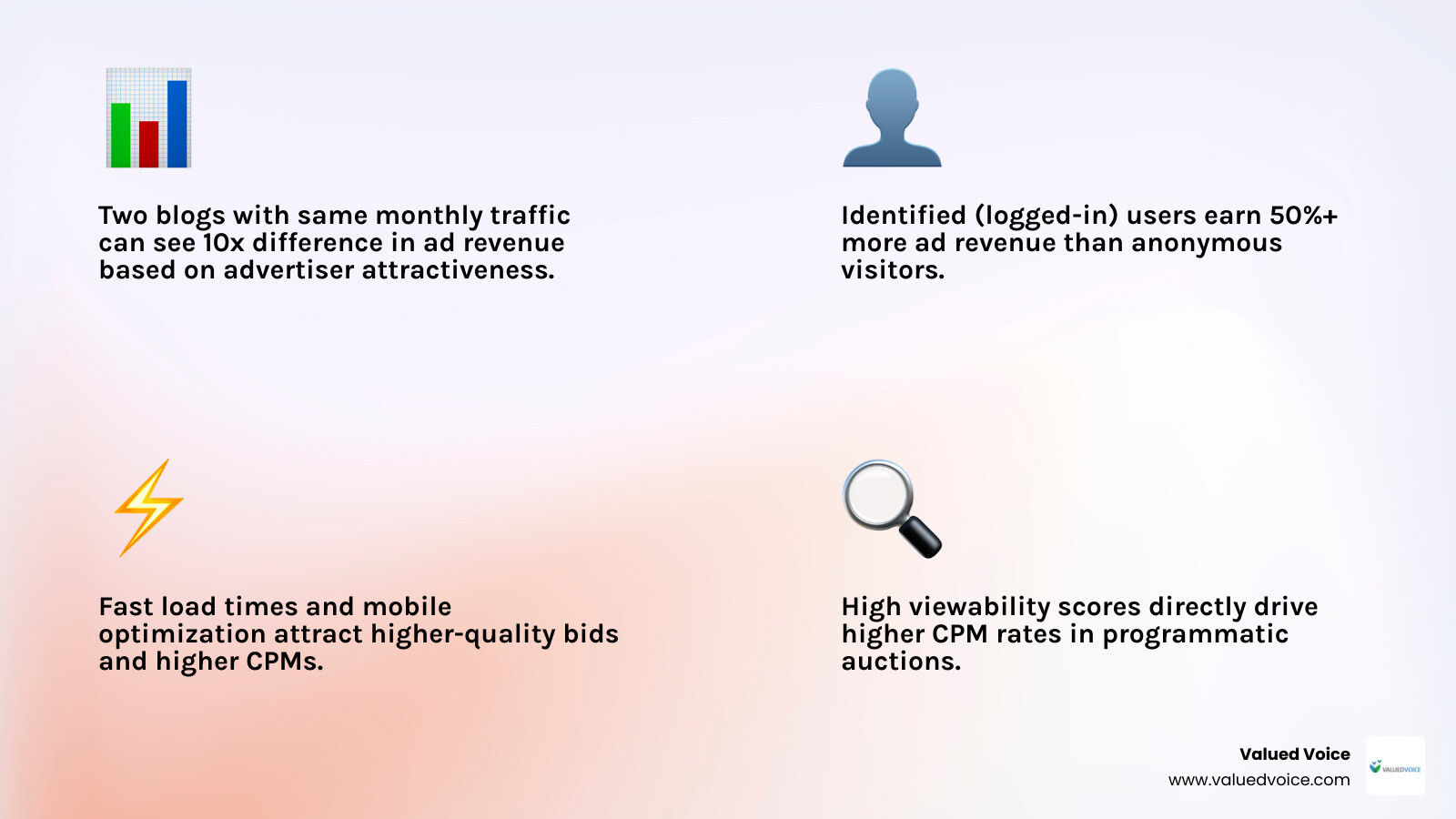
Not every website gets paid the same for the same traffic. Two blogs in the same niche, with the same monthly visitors, can end up with completely different revenue — sometimes 10x apart. That gap comes down to one thing: how attractive your site is to advertisers.
What makes a website attractive to advertisers comes down to a combination of content quality, audience trust, technical performance, and monetization infrastructure. Here is a quick breakdown:
| Factor | Why Advertisers Care |
|---|---|
| High-quality, niche-relevant content | Signals brand safety and audience intent |
| Strong traffic with verified identity | Identified users earn 50%+ more ad revenue |
| Fast load times and mobile optimization | Slow sites get fewer and lower-quality bids |
| Transparent trust signals (privacy policy, about page) | Required for ad network approval and DSP bidding |
| Healthy EPMV and documented revenue trends | Proves monetization potential to direct advertisers |
| Good search rankings (SEO) | Organic traffic is more valuable than paid or bot traffic |
| Smart ad placement and viewability | High viewability scores drive higher CPMs |
| Diversified demand partners | More competition = higher revenue per impression |
This guide covers every one of these factors in plain language — so whether you are a blogger trying to attract your first brand deal or a publisher looking to grow programmatic revenue, you will know exactly what to fix and what to build.
Discover more about What Makes a Website Attractive to Advertisers:
Core Metrics: What Makes a Website Attractive to Advertisers in 2026?
When advertisers look at our websites, they do not just see a collection of pretty pages; they see a spreadsheet of metrics. To secure the highest-paying ad budgets, we must understand the core performance indicators that media buyers use to evaluate our digital real estate.
Traffic Volume and Geographic Demographics
While raw traffic volume is the traditional entry barrier for premium monetization, where that traffic originates is often more critical than the total number of visits. Advertisers categorize traffic by geographic "tiers." Tier-1 regions — such as the United States, United Kingdom, Canada, and Western Europe — command significantly higher CPMs (Cost Per Mille) because consumers in these markets have higher purchasing power.
For instance, a finance article targeting US desktop users at peak hours can easily command a $15 to $50+ CPM, whereas the exact same content viewed by a mobile user in a Tier-3 region might yield less than $1.50. To make our sites irresistible, we must actively target high-value search intent that attracts these premium geographic demographics.
EPMV (Earnings Per Thousand Visitors) and RPM (Revenue Per Mille)
We often hear publishers talk about RPM, but EPMV is the true holistic metric of website health. While page RPM measures how much we earn from a specific page, EPMV tracks our total earnings across the entire visitor session. This accounts for users who click through multiple pages, generating multiple ad impressions. Advertisers look for websites with stable, upward-trending EPMV because it signals deep user engagement and highly optimized site layouts.
Click-Through Rates (CTR) and Viewable CPM (vCPM)
In 2026, the industry has fundamentally shifted from traditional Pay-Per-Click (CPC) to per-impression (CPM) and viewable CPM (vCPM) models. This means old click-optimization tricks are obsolete. Today, an ad must be seen to be valuable.
According to the Interactive Advertising Bureau (IAB) standard, a display ad is considered "viewable" if at least 50% of its pixels are visible on the screen for at least one continuous second. Premium Demand-Side Platforms (DSPs) apply real-time viewability multipliers to their bids. An ad unit on our site with an 80% viewability score can attract bids that are 2x to 3x higher than an identical unit with a 40% viewability score.
To help us visualize what premium advertisers look for compared to standard programmatic buyers, we can review the following benchmark metrics:
| Metric | Standard Ad Network Target | Premium Advertiser Target |
|---|---|---|
| Primary Geo Focus | Global / Mixed | Tier-1 (US, UK, CA, AU) |
| Average CPM Range | $1.00 – $5.00 | $10.00 – $50.00+ (Niche dependent) |
| Target Viewability Score | 40% – 50% | 70% – 85%+ |
| Audience Profile | Anonymous / Cookie-reliant | Logged-in / Subscribed / First-party identified |
| Content Alignment | General / High-volume | Highly specialized / Niche authority |
By restructuring our layouts to optimize these metrics, we can implement the strategies detailed in our guide on How to Increase Website Ad Revenue in 2026 to ensure our platform is fully prepared to capture enterprise-level marketing budgets.
Content Authority, Trustworthiness, and Search Visibility (SEO)
No advertiser wants their brand associated with low-quality, scraped, or untrustworthy content. To appeal to high-paying demand partners, we must build a fortress of content authority and strict brand safety.
High-Quality Content as a Foundation for What Makes a Website Attractive to Advertisers
At the heart of What Makes a Website Attractive to Advertisers is the absolute quality of our editorial material. General listicles and generic AI-generated roundups no longer cut it. Advertisers seek out niche-specific sites because they trigger the "expertise heuristic" in consumers — users naturally trust recommendations on specialized sites far more than general portals.
This is where Google’s E-E-A-T (Experience, Expertise, Authoritativeness, and Trustworthiness) framework directly intersects with programmatic ad revenue. If we operate in Your Money or Your Life (YMYL) or Your Money or Your Business (YMYB) niches, our content authority is scrutinized even more heavily.
Enterprise media buyers use automated third-party brand safety tools like Integral Ad Science (IAS) or DoubleVerify to scan our pages in milliseconds before placing a bid. If these scanners detect thin content, plagiarism, or high-risk topics, they will block our inventory from auctions entirely.
To prevent this, we must focus on original research, hands-on reviews with original photography, and deep topical authority. This is a core concept we emphasize in our resource on How to Start a Blog and our step-by-step blueprint to Grow Your Blog.
For a complete breakdown of how authority translates to monetization, refer to E-E-A-T for Publishers: How Content Authority Drives Ad Revenue as well as our Beginners Guide to Making Money Blogging.
Building Trust Through Transparency and Legal Compliance
Advertisers are highly risk-averse. Before an ad network or a direct brand approves our application, they will manually audit our site for basic trust signals. If our site looks like a temporary, fly-by-night operation, we will be rejected.
We must display several crucial elements in highly visible locations:
- An Up-to-Date Privacy Policy: Because personalized ads rely on cookies and user data tracking, a comprehensive privacy policy is a legal and network requirement.
- Clear Contact Information: Including a physical address, professional email, and phone number in our footer builds immediate institutional credibility.
- A Detailed "About Us" Page: We should avoid cold stock photos. Instead, we must display real photos of our team, our editorial guidelines, and our mission statement to put a human face on our digital business.
- A Flawless Ads.txt File: This public text file lists the specific demand partners authorized to sell our ad inventory, preventing domain spoofing and ad fraud.
- A Compliant Consent Management Platform (CMP): DSPs will not bid on European or Californian traffic unless a valid user consent string (complying with GDPR and CCPA) is passed through the bid stream.
For a practical look at setting up these trust signals, check out How to Monetize a Website With Ads: A Practical, Honest Guide.
Why Identified Traffic is What Makes a Website Attractive to Advertisers
With the ongoing deprecation of third-party cookies, the digital advertising landscape has changed forever. Advertisers can no longer track users across the web using standard cookies. As a result, they are willing to pay a massive premium for identified or logged-in traffic.
Publishers who encourage users to subscribe, create free accounts, or log in to access premium content are seeing incredible financial returns. Across major ad networks, publishers with identified, logged-in visitors are earning more than 50% more revenue than they do from unidentified users on otherwise identical traffic. In fact, total identified revenue across advanced publisher networks grew an astronomical 6x year-over-year recently.
By building a loyal, registered audience, we transform anonymous clicks into a valuable first-party data asset. Learn more about leveraging this transition in our deep dive on How to Make Money Blogging.
User Experience, Design, and Technical Performance
An attractive website is a fast, highly functional website. No matter how incredible our content is, poor technical execution will actively destroy our ad revenue potential.
Mobile Optimization and Core Web Vitals
Over 60% of global web traffic is mobile. If our mobile experience is clunky, we are missing out on the majority of our potential earnings. Furthermore, Google's Core Web Vitals directly influence both our search engine rankings and our ad delivery. Slow-loading sites receive lower-quality ads and fewer bid requests from premium buyers.
We must optimize for three primary metrics:
- Largest Contentful Paint (LCP): The main content of our page must load in under 2.5 seconds.
- Cumulative Layout Shift (CLS): Our page elements must remain stable as they load. If an ad suddenly pops in and pushes our text down, it causes a layout shift. We must set explicit width and height CSS rules (using min-height containers) to reserve space for ad units before they render, keeping our CLS score under 0.1.
- Interaction to Next Paint (INP): Our pages must respond instantly to user clicks and inputs (under 200 milliseconds).

To keep our site running at lightning speeds, we should avoid heavy widgets, limit excessive external scripts, and follow the Google AdSense Best Practices 2026 to ensure our code remains clean and compliant.
Balancing Ad Placement Strategy and User Experience
We face a perpetual dilemma: we must send a portion of our visitors to our advertisers to generate revenue, yet we must retain enough visitors to grow our own audience. Overloading a page with ads creates a chaotic user experience, leading to high bounce rates and a negative feedback loop that harms our SEO.
To find the perfect balance, we must implement a highly strategic ad layout:
- Ad Density Limits: We should adhere to a strict density rule of one ad unit per 300 to 400 words of content, capping total ad units at 3 to 5 per page for standard articles.
- Sticky Sidebars (Desktop): Implementing a sticky sidebar ad keeps the unit in view as the user scrolls, boosting viewability by 20% to 30% without cluttering the main text.
- Anchor Ads (Mobile): A slim, bottom-anchored mobile ad (capped at 50px to 100px in height with a clear, functional close button) yields 15% to 25% higher revenue due to constant viewability.
- Lazy-Loading Ads: By utilizing lazy-loading scripts (such as
IntersectionObserver), we delay the rendering of below-the-fold ads until the user scrolls within 200px to 300px of the ad container. This protects our initial page load speed while ensuring that every rendered ad has a high probability of being seen. - Viewability-Gated Refresh: Instead of refreshing ads on a simple timer, we should only trigger an ad refresh if the unit has been active in the viewport for at least 30 to 45 seconds, the browser tab is active, and the user is actively interacting with the page.
For a masterclass in layout engineering, consult the Ad Revenue Optimization Playbook.
Monetization Infrastructure and Revenue Documentation
To truly maximize our earnings, we must move beyond basic, single-demand setups. The most attractive websites operate on a sophisticated programmatic bidding infrastructure and maintain flawless financial documentation.
If we rely solely on a single ad network, we are essentially selling our ad space to the first bidder without checking market rates. Instead, we should implement header bidding using Prebid.js. This open-source wrapper allows us to connect our inventory to 5 to 8 premium Supply-Side Platforms (SSPs) simultaneously. When a user lands on our site, these demand partners compete in a real-time, parallel auction in milliseconds, forcing buyers to bid their absolute maximum price to secure our ad space.
Furthermore, we must be aware of "supply chain leakage." Industry data shows that only about 36 cents of every dollar entering a Demand-Side Platform (DSP) actually reaches the publisher, with the rest lost to intermediaries, hidden fees, and Made-for-Advertising (MFA) arbitrage. By cleaning up our monetization stack, working with transparent demand partners, and documenting our historical EPMV trends over 12 to 24 months, we build an incredibly valuable digital asset.
When we can clearly document our demand partners, ad configurations, and traffic quality, we make our site highly appealing to premium sponsors. This structural transparency opens up lucrative Sponsored Post Opportunities and direct brand collaborations. For a comprehensive look at setting up this advanced programmatic infrastructure, read How to Monetize a Website with Ads: A Complete Guide for Publishers in 2026.
Frequently Asked Questions about Website Monetization
Why do advertisers value logged-in or identified traffic over anonymous visitors?
With the deprecation of third-party cookies, advertisers can no longer target anonymous users based on cross-site browsing history. Logged-in or identified traffic provides verified first-party data (such as emails, user preferences, and registration details). This allows advertisers to target specific, highly addressable audiences with precision, leading to a 50%+ lift in CPMs for publishers. Learn more about modern monetization models in our guide on How to Earn Money Online.
How does ad density affect both user retention and advertiser interest?
High ad density creates visual clutter, triggers "ad fatigue," and slows down page load speeds, which severely damages Core Web Vitals and increases bounce rates. For advertisers, crowded pages dilute user attention, lowering the individual viewability and click-through rates of their ads. Maintaining a balanced density (one ad per 300 to 400 words) preserves user retention while driving up auction competition and CPMs. Explore how to build clean, profitable side hustles in our resource on How to Make Money on the Side.
What documentation should I provide to appeal to direct advertisers?
To attract direct advertisers and secure high-paying sponsorships, we should provide a professional media kit containing:
- Verified traffic data (such as Google Analytics 4 screenshots showing monthly unique visitors, page views, and average session duration).
- Audience demographics (geographic distribution, age ranges, and key interests).
- Historical monetization performance (including EPMV trends and viewability scores).
- A clear menu of collaboration options, such as banner placements, newsletter features, or Paid Guest Post Opportunities.
Conclusion
Making a website highly attractive to advertisers is not about chasing quick traffic hacks or over-commercializing our pages. It is a deliberate, structural process of building high-quality, niche-specific content, earning our audience's trust through transparency, optimizing our technical performance for speed and mobile devices, and implementing a competitive, multi-SSP programmatic infrastructure.
When we focus on creating a fast, authoritative, and user-friendly platform, the premium ad revenue naturally follows. If you are ready to take your website monetization to the next level, we invite you to join us at Valued Voice.
Our content creator platform connects bloggers and influencers directly with top-tier brands for high-paying sponsored content. With our fast, free, and easy-to-use system, you retain full price control, absolute editorial freedom, and enjoy incredibly quick payouts. Register today to start turning your hard-earned traffic into a highly profitable digital asset, and stay tuned to the Valued Voice Blog for the latest industry insights and monetization strategies.
Join over 10,000 bloggers and content creators who are currently earning with Valued Voice!