
Key Takeaways
- Choose ambassadors for genuine brand affinity, audience fit, and engagement quality, not follower count alone.
- Start with a pilot, set clear goals and rewards, and treat ambassadors as long-term creative partners.
- Measure your own referral and retention outcomes rather than assuming published case-study results will repeat.
- Clearly disclose material connections and agree on content usage rights before launching campaigns.
Table of Contents
- 1. Brand Ambassador Program Basics: How It Works
- 2. What Is a Brand Ambassador Program and How Does It Work?
- 3. Key Benefits of Building Customer Advocacy
- 4. How to Build and Scale Customer Advocacy
- 5. Real-World Examples and Compliance Best Practices
- 6. Frequently Asked Questions About Ambassador Programs
- 7. Conclusion
A brand ambassador program is a long-term partnership in which customers, creators, or industry professionals promote a brand through genuine recommendations, referrals, and content. In return, they may receive products, discounts, payment, or other perks. This guide explains how to recruit the right advocates, structure incentives, and build a program that supports lasting customer advocacy.
Brand Ambassador Program Basics: How It Works
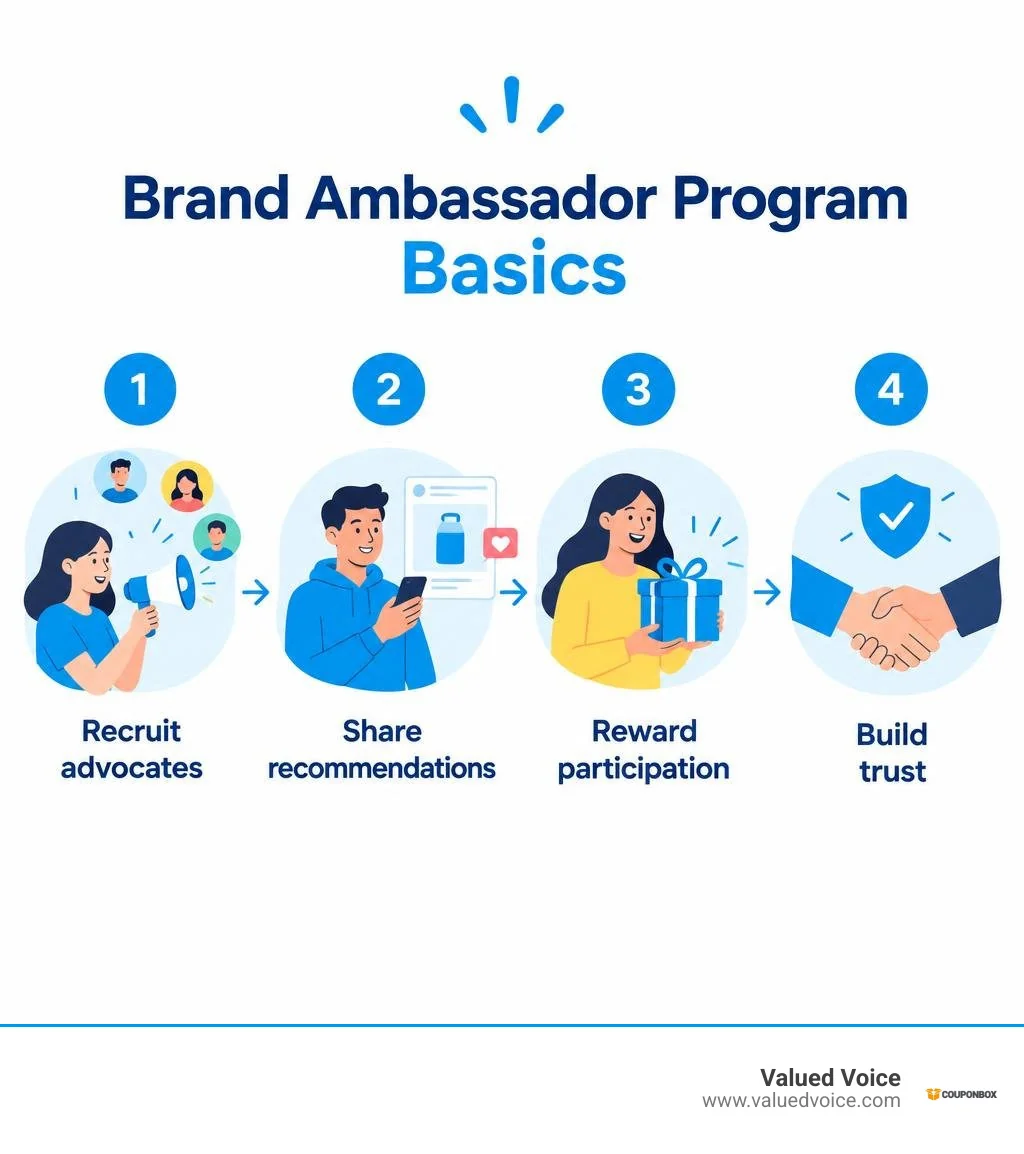
A brand ambassador program is an ongoing partnership where people who know and like a brand recommend it to others. Ambassadors may share posts, answer questions, or refer customers. In return, they may receive payment, products, discounts, or other perks.
For creators, the key difference from a one-off sponsored post is the long-term relationship. This guide covers how brands choose ambassadors, what rewards to expect, and how to tell whether a program fits your audience.
What Is a Brand Ambassador Program and How Does It Work?
Advocacy marketing focuses on genuine relationships rather than short-term ad buys. A well-run brand ambassador program gives loyal customers, content creators, and industry professionals a structured way to share their real experiences. Instead of relying solely on paid ads that disappear once a budget runs out, companies build an engine of ongoing recommendations that drives sustainable customer retention and brand affinity.
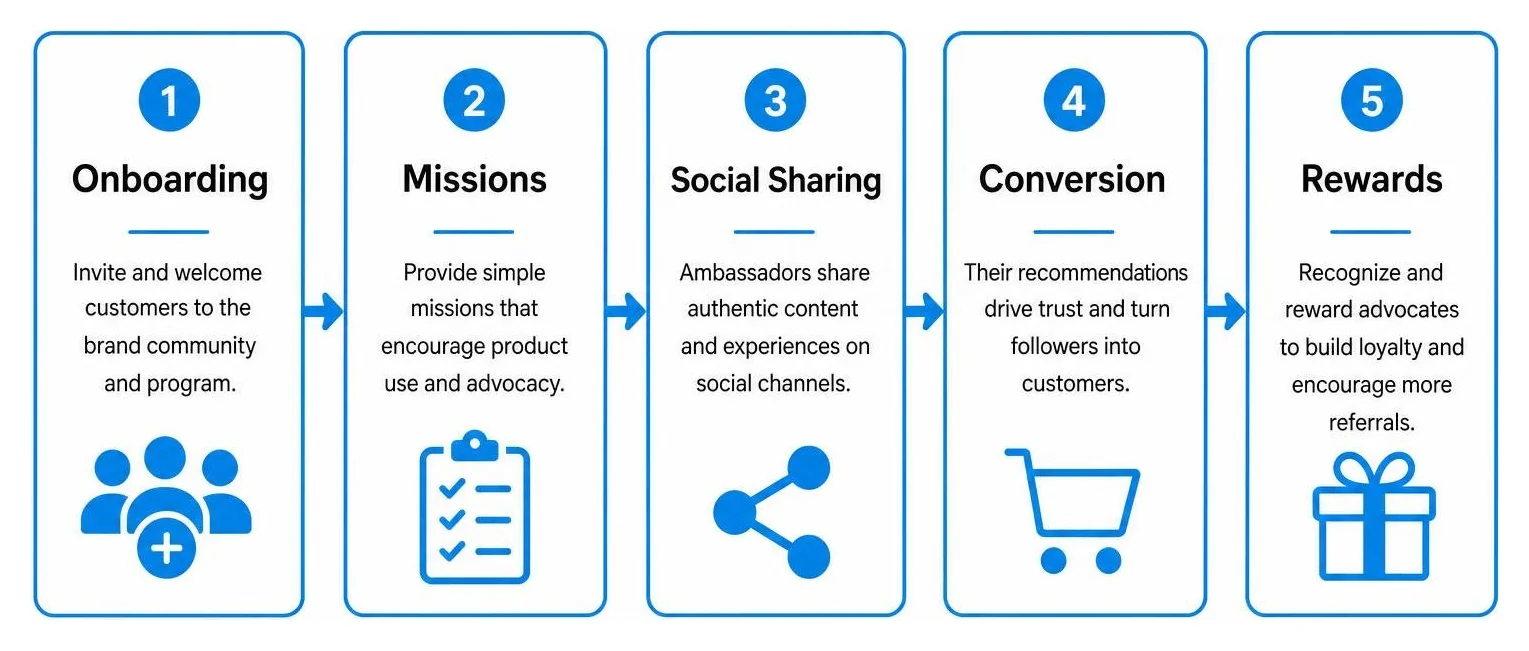
Ambassadors typically receive an onboarding package, unique referral links or discount codes, creative briefs or missions, and access to an exclusive community hub. They introduce products to their networks, demonstrate daily usage, answer follower questions, and provide direct feedback to the marketing team.
| Feature | Brand Ambassador Program | Traditional Influencer Campaign | Affiliate Marketing Program |
|---|---|---|---|
| Relationship Length | Ongoing, multi-month or annual | Short-term, single campaign | Purely transactional / continuous |
| Primary Goal | Trust, advocacy, loyalty, and LTV | Broad reach and instant awareness | Direct sales conversions |
| Compensation | Hybrid (perks, products, pay, bonuses) | Flat campaign fee per deliverable | Usually commission-based; other arrangements may apply |
| Audience Focus | Niche, highly engaged communities | Broad, high-volume reach | Searchers and price-sensitive shoppers |
| Content Style | Authentic routines and peer discussions | Polished, scripted creative assets | Product links and review banners |
Core Role of a Brand Ambassador
The main job of a brand ambassador is to represent a company authentically over an extended period. Rather than reading a rigid script, ambassadors weave products naturally into their daily lives, routines, and professional work.
Ambassadors generate genuine word-of-mouth recommendations that carry far more weight than traditional banner ads. They act as a trusted bridge between the company and potential buyers by providing honest tutorials, hosting styling sessions, answering product questions, and sharing feedback directly with product teams.
Brand Ambassador vs. Influencer Models
One-off influencer campaigns often emphasize awareness, while ambassador programs can support ongoing education, trust, and repeat purchases. These models overlap: influencers can drive conversions, and ambassadors can introduce a brand to new audiences.
Aligning an overall influencer marketing strategy with an ambassador tier allows brands to maximize both reach and credibility. One-off sponsored posts introduce a brand to a new audience, while ambassadors maintain the ongoing touchpoints needed to turn curious viewers into repeat buyers.
Key Benefits of Building Customer Advocacy
Recommendations from people customers trust can help them discover and evaluate products. Investing in structured customer advocacy gives brands a way to support these conversations and learn which recommendations lead to engagement, referrals, and repeat purchases.
A 2011 study of approximately 10,000 German bank customers found that referred customers had at least 16% higher average value than comparable nonreferred customers, as well as higher retention. These findings describe one referral-program setting, not a guaranteed result for every ambassador program.
Long-Term Customer Retention and Lower CAC
Rising digital ad costs make acquiring customers via paid social increasingly expensive. Ambassador programs help offset high customer acquisition costs (CAC) by driving organic referrals and user-generated content that can be reused across marketing channels.
A useful brand community gives customers reasons to return: product education, helpful answers, feedback opportunities, and relationships with other members. Track retention and referral outcomes against your own baseline rather than assuming community membership alone causes loyalty or sales.
Scaling High-Converting User-Generated Content
Social commerce depends heavily on social proof. An active community of creators and advocates supplies a steady volume of authentic images, short-form videos, and real-life reviews.
Brands often distribute these creative assets across product detail pages, paid ad units, and email newsletters. Creators seeking new partnerships can explore various sponsored post opportunities to expand their portfolios and collaborate with companies looking for authentic content.
How to Build and Scale Customer Advocacy
Launching an effective advocacy program requires moving beyond ad-hoc outreach and establishing a clear, repeatable system.

Essential Steps to Launch a Brand Ambassador Program
- Define program goals and success metrics: Establish clear benchmarks, whether the primary focus is user-generated content volume, referral revenue, community engagement, or reduced support tickets.
- Identify your ideal ambassador profile: Determine whether your program targets superfan customers, nano-creators, or certified industry professionals.
- Design the incentive and compensation structure: Build a model that balances free merchandise, tiered commissions, community perks, and monetary stipends.
- Create a streamlined application process: Set up a clean landing page capturing contact info, social handles, audience demographics, and authentic brand sentiment.
- Develop brand assets and creative guidelines: Provide ambassadors with logos, key talking points, product education, and tracking links while leaving room for creative freedom.
- Launch, communicate, and optimize: Introduce the program to existing buyers, maintain regular communication through monthly missions, and refine based on performance data.
Start with a small pilot and test different campaign approaches before scaling. Advertise the application through your website, social channels, and newsletter, clearly explaining your brand, expectations, and compensation.
Treat ambassadors as business peers: listen to their goals, invite feedback into planning discussions, and give them room to speak in their own voice within clear disclosure and brand guidelines. Keep regular conversations about content schedules and rewards, and use referral codes alongside longer-term awareness and retention measures rather than expecting immediate sales alone.
Identifying and Qualifying the Right Creators
Successful programs prioritize brand affinity over raw follower numbers. Look for creators who already purchase your products, tag your handles naturally, or engage with your posts. Review their audience engagement rates, content quality, and comment sections to verify authentic community interactions before onboarding them. Those interested in how to find the influencers to help you meet your goals should focus on genuine alignment, audience trust, and creative consistency rather than vanity metrics alone.
Structuring Rewards for a Brand Ambassador Program
A balanced reward structure keeps ambassadors motivated over the long haul. Effective incentive models include:
- Product discounts and free merchandise: Quarterly product drops, exclusive merchandise, and personal discount codes.
- Tiered cash commissions and gift cards: Performance-based earnings linked directly to tracked referral sales.
- Points and bankable rewards: Systems where completing missions (e.g., leaving a review, submitting UGC, sharing a tutorial) earns points redeemable for products or cash.
- VIP experiences and brand exposure: Early access to product launches, invitations to private virtual masterclasses, and features on official brand social channels.
For example, the UNICE Brand Ambassador Program offers quarterly product drops alongside tiered commissions, exclusive checkout discounts, and global social reposts to reward active creator participation.
Real-World Examples and Compliance Best Practices
Leading brands across beauty, retail, and professional services demonstrate how community-led ambassador programs generate tangible business outcomes.
Enterprise Brand Case Studies
- L’Oréal: Redken, part of the L’Oréal group, illustrates a professional-creator approach: product education, creative missions, and peer networking support ongoing advocacy. See the sourced Redken example below rather than treating an unverified group-wide reach figure as a benchmark.
- Redken: In its Redken Insiders case study, program provider Skeepers reports more than 25,000 pieces of user-generated content and says Insiders account for 60% of Redken social mentions. These are provider-reported program results, not independent performance guarantees.
- Superdrug: Skeepers’ Superdrug case study reports a 60% conversion uplift after community interaction and a 5.6% average order value uplift among shoppers engaging with the community. These comparisons do not establish that every shopper or ambassador program will see the same change.
- NARS: Skeepers’ NARS case study describes a community of 32,000 members, with 30% active members and a 27% community interaction rate. It also attributes 5% of revenues to community members; the report does not establish a worldwide company-revenue figure or prove incremental sales.
Legal Guidelines and FTC Disclosures
Transparency is essential for maintaining consumer trust and legal compliance. The Federal Trade Commission’s disclosure guidance explains that endorsements must make material connections obvious, including payment, employment, free products, and discounts. U.S. requirements can apply to posts from abroad when effects on U.S. consumers are reasonably foreseeable; other laws may also apply.
- Clear and conspicuous placement: Disclosures must appear prominently in the caption, video overlay, or audio track—not buried in a cluster of hashtags or hidden behind a "more" link.
- Use clear disclosure language: Terms such as
#adand#sponsored, or a plain explanation that the brand provided a free product, can make the relationship clear when prominently placed. The FTC also gives brand-specific examples such as “AcmePartner” or “Acme Ambassador” on space-limited platforms. Stand-alone#ambassador, vague#collab, or shorthand such as#spmay not communicate the relationship clearly; no tag alone guarantees compliance. - Clear usage rights: Contracts must define who owns the created content, how long the brand can use it in paid ads, and whether exclusivity is required.
Frequently Asked Questions About Ambassador Programs
How much do brand ambassadors typically get paid?
Ambassador compensation varies based on industry, audience, deliverables, content usage rights, and exclusivity. Some programs provide gifted products, discounts, or store credit; others offer affiliate commissions, flat fees, or recurring retainers. Review the specific program’s written terms rather than treating an unsourced commission or monthly-pay range as a standard rate.
Do brand ambassadors need a large social media following?
No. Some programs welcome everyday customers or smaller niche creators, while others set follower or professional-qualification requirements. Assess audience fit, genuine product experience, and engagement quality rather than assuming a large following is necessary or that smaller accounts always convert better.
How long does it take to see measurable results?
Timing depends on recruitment, onboarding, content schedules, purchase cycles, and the goals you measure. Track early indicators such as completed onboarding and content submissions, then evaluate referrals, repeat purchases, and acquisition costs over a suitable period. There is no universal two-week launch payoff or three-month maturity guarantee.
Conclusion
A well-structured ambassador program transforms organic customer loyalty into a measurable, scalable growth channel. By focusing on long-term relationships, educational value, and fair reward systems, companies can generate authentic social proof, improve customer retention, and lower overall acquisition costs.
For brands and creators ready to collaborate on authentic campaigns with clear pricing and editorial control, our content creator platform at Valued Voice connects bloggers and influencers directly with top brands for paid sponsored partnerships. Launching a dedicated brand ambassador program ensures your business stays visible, authentic, and resilient in an evolving digital landscape.